The Police National Legal Database breach did not create the first publicly accessible list of police officers. Forces already publish named and contactable neighbourhood officers as part of a national policy commitment. In some cases, those pages provide more detail about an individual officer than the information PNLD has confirmed as compromised.
The breach remains important because it took information released for no legitimate public purpose and consolidated people across policing, criminal justice, government and members of the public. The meaningful questions are therefore not simply whether a name or work email was exposed, but whose details were included, how easily the data can be searched and combined, and whether particular people face risks not shared by the majority.
What is actually known
PNLD identified a data-security incident on 26 July. Its public notice, issued on 2 August, confirms that names, organisations and work email addresses belonging to police officers, police staff, criminal justice professionals, government partners and customers were compromised and published on the dark web.
PNLD says there is no evidence that passwords or other security credentials were compromised. It has also stressed that PNLD is a legal information service, not a crime-recording system, and does not hold confidential information about victims, witnesses or offenders.
The incident also affected Ask the Police. Some people who had previously submitted questions had their names and email addresses published. PNLD says affected organisations and Ask the Police users were contacted and provided with further information and guidance. It notified the Information Commissioner’s Office and is working with the National Crime Agency and specialist cyber-security organisations.1
Claims about approximately 114,000 PNLD subscribers and a wider dataset of around 135,000 records have been reported, but PNLD has not publicly confirmed a final number. Nor has it publicly explained how access was obtained, how long it was available, whether every record contained the same fields or whether the investigation has established subsequent misuse.6
Those distinctions are important. A work email address is personal data, but it is not a home address, personal telephone number, password, financial record, operational posting or intelligence report. “Police database breached” can easily be understood as “police records exposed”. That is not what PNLD has confirmed.
The Neighbourhood Policing Guarantee changes the comparison
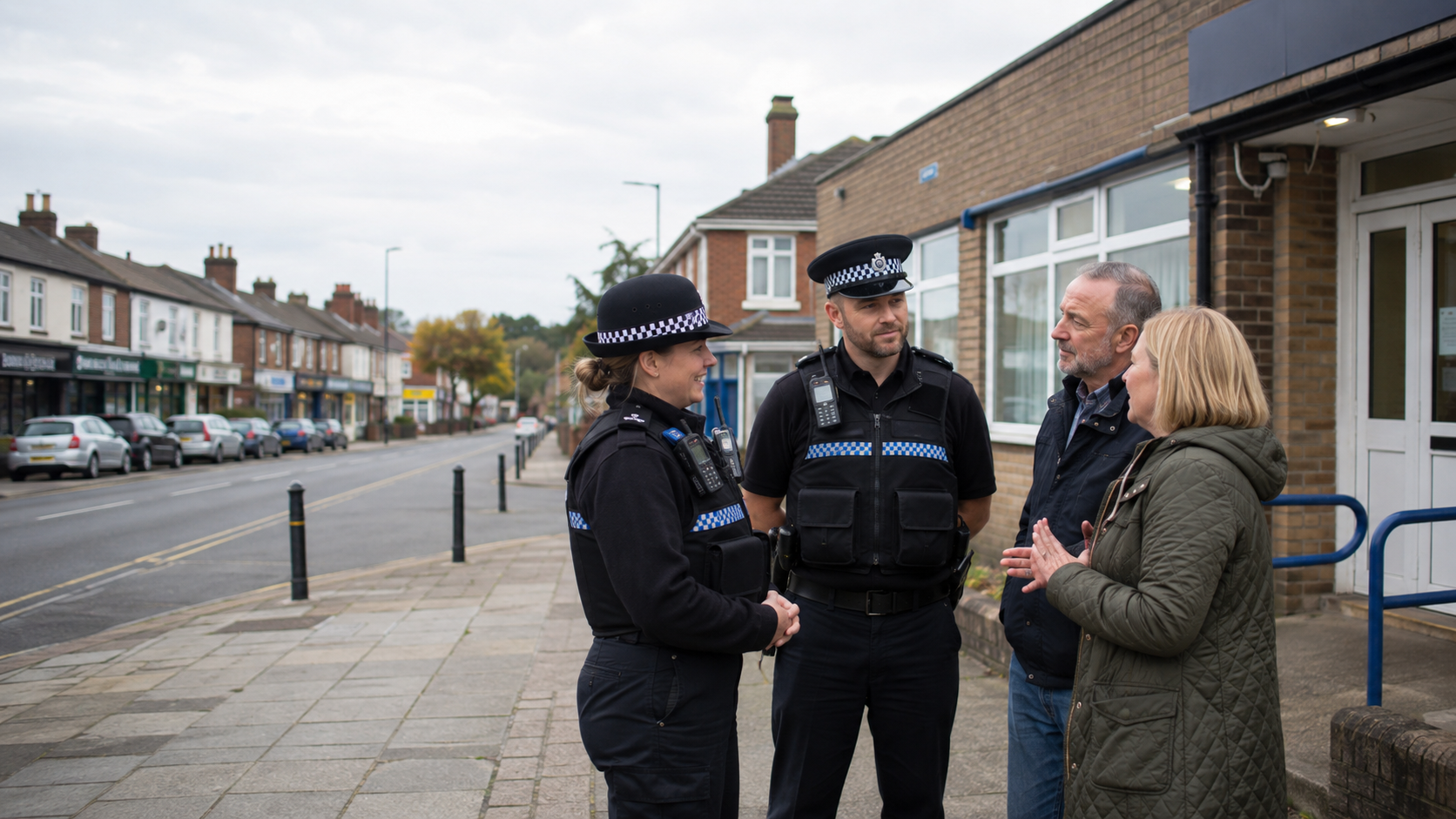
Under the Neighbourhood Policing Guarantee, every community in England and Wales must have named and contactable officers dedicated to its local problems. Forces must also publish information about neighbourhood teams and local priorities.3
The NPCC subsequently reported that every force had created dedicated pages containing local-team details, contact information, meeting dates and current priorities.4
The precise information varies. The Guarantee requires officers to be named and contactable; it does not specifically require every force to publish a direct personal email address, photograph, collar number or exact working location. Some force pages nevertheless publish several of those details.
For an individual neighbourhood officer, an official force page may disclose more usable information than the confirmed PNLD record. The difference is aggregation, coverage and context.
Neighbourhood information is deliberately published for a defined purpose. It covers a category of public-facing officer, is divided across local pages and is maintained as part of an accountable service. The PNLD information was taken and released without authorisation. It consolidates people across organisations, including roles that have no public-contact purpose. It also includes members of the public who used Ask the Police.
A person seeking the identity of a particular neighbourhood officer may already be able to obtain it from the relevant force. A person seeking a large, searchable collection of verified police and criminal justice work identities has gained something different. Bulk data reduces the effort required for phishing, impersonation, hostile research and matching records against information obtained elsewhere.
Risk should be assessed, not imagined
On the evidence currently available, significant direct harm to most affected police officers appears unlikely. The most credible general risk is targeted phishing and social engineering. A message containing a recipient’s name, organisation and authentic work-email format may appear more convincing than indiscriminate spam. The data could also assist somebody impersonating an officer or criminal justice professional.
Those are real but familiar risks. They do not justify treating every affected person as facing a physical-security threat.
A smaller group may require a different assessment. This could include people in sensitive or covert roles, those whose occupation was not previously public, officers or staff experiencing stalking or domestic abuse, people with protected identities and anyone already subject to a specific threat. A low average risk does not mean that every record carries the same risk.
The Ask the Police exposure needs separate consideration. The known fields may be limited to names and email addresses, but the fact that somebody asked the police a question could itself be sensitive. PNLD has not publicly stated whether question content, subject categories or other contextual information were accessible.
| PNLD: confirmed position | PSNI 2023 | |
|---|---|---|
| Principal fields | Name, organisation, work email | Surname, initial, rank, role, department, work location and service/staff number |
| Coverage | PNLD users across several organisations and some Ask the Police users | Entire PSNI workforce |
| Known threat context | No public evidence of realised harm so far | Data obtained by dissident republicans |
| Publicly recorded impact | Not yet established | Anxiety, security costs and changes to people’s lives |
This is not, on the evidence so far, equivalent to the 2023 PSNI breach. Importing that threat assessment into the PNLD incident would be unsound. So would waiting for comparable harm before communicating properly.5
The public account remains incomplete
It would be wrong to say that there has been no public statement. PNLD published a notice, the incident has been reported widely, and the Police Federation has publicly raised concerns about officer and staff safety.
It would also be wrong to say that no support has been provided. PNLD states that affected organisations and Ask the Police users received information and guidance. Forces may have supplied further advice internally.
The defensible criticism is narrower: the risk assessment, guidance and support have not been described publicly in sufficient detail.
A review of available official public material on 25 August found no substantive PNLD update beyond the original notice. There is no published explanation of:
- the final number of affected people;
- whether different groups had different fields exposed;
- the assessed likelihood of phishing, harassment or physical harm;
- whether any resulting misuse has been identified;
- what affected officers and staff were advised to do;
- what support is available to somebody with particular safety concerns;
- which organisation owns individual risk assessments; or
- when the next public update will be issued.
Not every operational or security detail should be published. Investigations require confidentiality and releasing exact protective measures may be counterproductive. That does not prevent a short, evidence-based account of the risk and response.
A proportionate response
The response should distinguish between general mitigation and exceptional safeguarding.
There is no evident basis for indiscriminate password resets if credentials were not compromised. Equally, an officer in a sensitive role should not be given only generic phishing advice if their circumstances justify a fuller review.
A public update should answer six basic questions:
- 01What information has now been confirmed as compromised?
- 02How many people are affected, divided into meaningful categories?
- 03What important information was not exposed?
- 04Has any resulting misuse or harm been identified?
- 05What should affected people do, and where can they obtain individual support?
- 06When will the next update or final lessons report be published?
What should happen next
PNLD and West Yorkshire Police should publish a one-page risk and response update. Each force should ensure affected personnel know how to request an individual security or welfare review, with particular attention to sensitive roles and existing personal risk.
The national response should record suspected misuse, high-risk cases reviewed, support requested, incidents linked to the compromised information and the time taken to resolve concerns. Without those measures, any later claim that the breach caused little harm will remain an assumption rather than a finding.
The most likely assessment may still be reassuring. For most officers, publication of a name, organisation and work email address probably adds only modest risk to information already public, predictable or obtainable through ordinary professional contact.
But that conclusion should be communicated and evidenced. The PNLD breach is not another PSNI. It is also not nothing.
References
- PNLD: official data-breach notification
- PNLD homepage and latest notices
- Home Office: Neighbourhood Policing Guarantee
- NPCC: implementation of the Neighbourhood Policing Guarantee
- ICO: findings and harm arising from the PSNI data breach
- Info-Gov: PNLD reporting, Federation response and unconfirmed claims